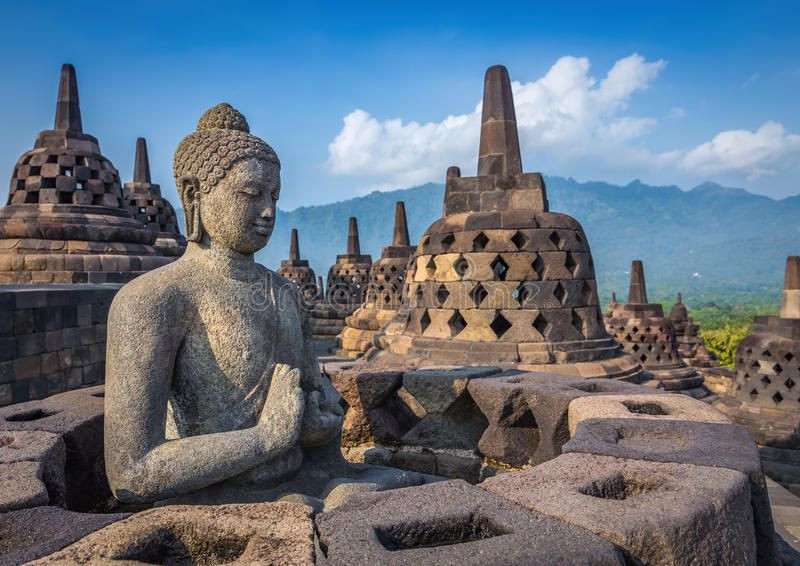

The Borobudur relief panels are among the most detailed artistic features of this ancient Buddhist monument. Carved into the stone walls of its galleries, the panels portray religious stories, moral lessons, people, animals, architecture, and scenes from everyday life. Together, they create a visual journey that complements Borobudur’s unique architectural design.
Understanding Borobudur Relief Panels
The relief panels are integrated into the walls surrounding Borobudur’s square terraces. Visitors encounter them while walking through the monument’s gallery pathways.
Rather than presenting one continuous story in a single location, the panels form an extensive collection of scenes across different sections of the monument. Their placement allows visitors to discover the artwork gradually while moving from one terrace to another.
This combination of walking and viewing makes the reliefs an important part of the overall Borobudur experience.
Stories and Buddhist Teachings
Many of the Borobudur relief panels are connected with Buddhist narratives and teachings. They portray stories that explore human behavior, morality, compassion, and the consequences of actions.
The scenes contain numerous human figures engaged in different activities. Religious characters appear alongside ordinary people, animals, buildings, and natural elements.
For visitors unfamiliar with Buddhist literature, the panels can still be appreciated as detailed examples of ancient storytelling through stone.
Everyday Life in the Reliefs
One fascinating aspect of the panels is the representation of everyday life. Artists carved scenes showing clothing, buildings, transportation, social activities, and different environments.
These details provide a visual connection to the world represented in the monument. Ships, houses, trees, animals, and human figures appear throughout the relief sequences.
By examining these smaller elements, visitors can discover information that may be overlooked when viewing the relief walls from a distance.
The Craftsmanship Behind the Panels
Creating the relief panels required considerable planning and craftsmanship. Artists had to work directly with stone surfaces while maintaining proportions and details across large compositions.
Figures are arranged at different depths to create visual separation. Decorative patterns and architectural elements help frame individual scenes.
The consistency across the galleries demonstrates how the reliefs were incorporated into a larger architectural plan rather than created as isolated artworks.
For a broader explanation of Borobudur’s structure and its relationship with the reliefs, this Borobudur inside guide provides additional context.
Hidden and Visible Relief Panels
Most visitors see the relief panels along the main galleries, but Borobudur also has a concealed relief series at its hidden base.
These panels became enclosed when additional stonework was added around the original lower structure. Their existence shows that Borobudur’s artistic program extends beyond the sections that can be easily viewed today.
The hidden reliefs provide another perspective on the monument’s development and demonstrate the complexity of its original design.
How to Appreciate the Reliefs
Visitors can get more from the Borobudur relief panels by taking time to examine individual scenes. Look at the expressions of the figures, their clothing, surrounding architecture, and smaller details in the background.
It can also be helpful to observe how the reliefs change as you move through different terraces. The architectural setting influences how each group of panels is experienced.
Rather than trying to see everything at once, focusing on a few sections can reveal details that are easy to miss.
Discovering Borobudur Through Its Reliefs
The Borobudur relief panels demonstrate how art, architecture, and religious storytelling can exist within one monumental structure. Their detailed scenes transform the gallery walls into an extensive visual record.
Travelers interested in exploring Borobudur and other cultural attractions in Central Java can discover more through Borobudur Tours.
From Buddhist narratives to scenes inspired by everyday life, the relief panels offer countless details to explore. Understanding their role can make a visit to Borobudur more informative and provide a deeper appreciation of its ancient artistic heritage.